Listen to this article
The next time you slice a mushroom into your morning omelette, consider this: you and that mushroom share more DNA than the mushroom shares with the plant which grew next to it. Fungi are not plants. And their closest living relatives, it turns out, are us. Fungi are organisms that had spent billions of years quietly decomposing the world beneath our feet
The Great Divorce and the Reunion
For centuries, fungi lived in a taxonomic limbo. Aristotle lumped them with plants. Medieval herbalists catalogued them beside mosses and lichens. Even Linnaeus, the father of modern taxonomy, categorised them under Plantae. It took the ability to compare DNA sequences directly to expose just how wrong we had been.
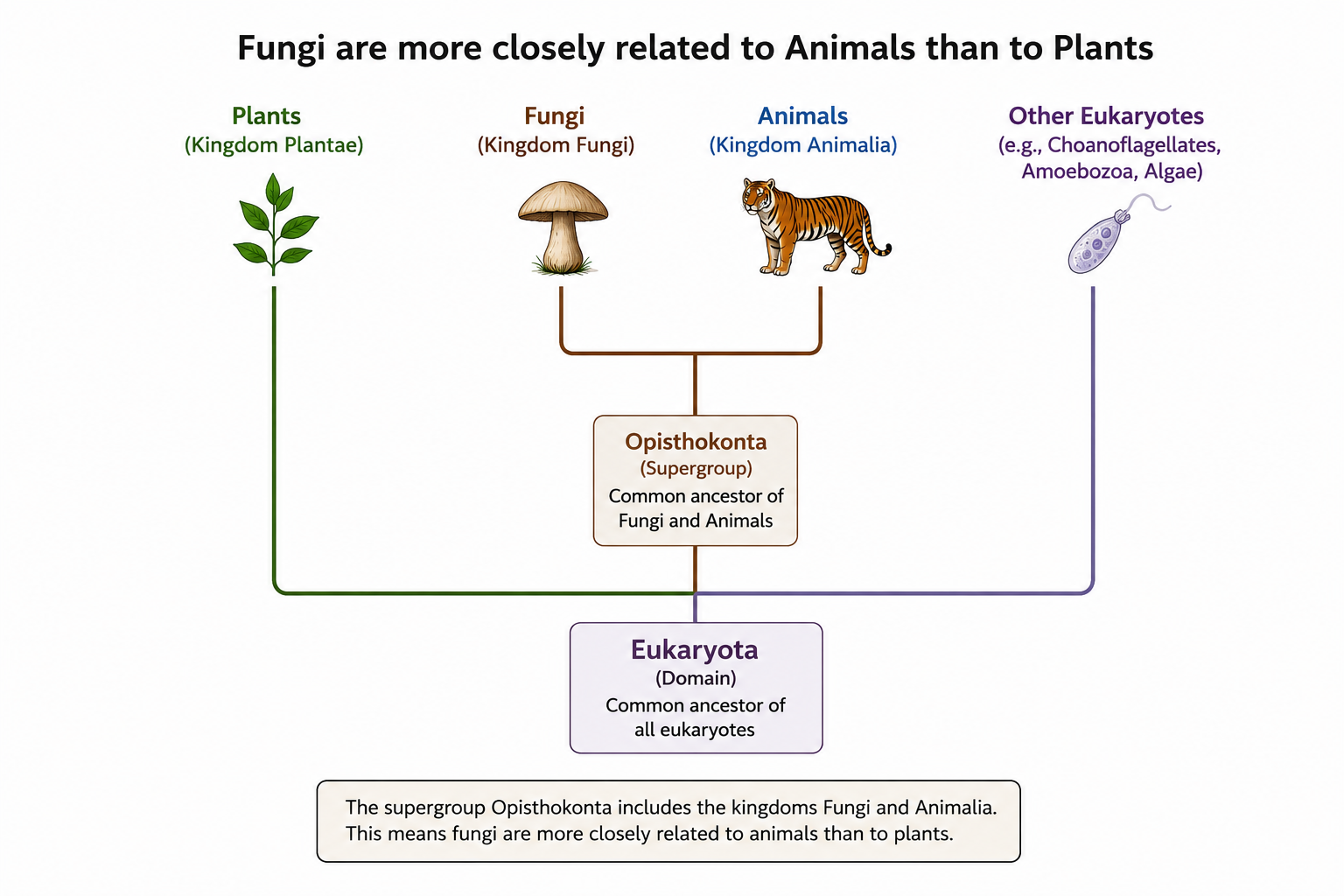
In the early 1990s, researchers sequencing ribosomal RNA genes noticed something alarming: fungi clustered consistently with animals, not plants. Further analysis confirmed it. Fungi and animals share a common ancestor that plants do not. The last universal common ancestor of you and a portobello mushroom lived roughly 1.5 billion years ago.
The two kingdoms : Fungi and Animalia , are now grouped together in a clade called Opisthokonta, a name derived from the Greek for "rear flagellum." The single defining ancestral feature: their sperm and motile cells swim with a flagellum at the back, the same design found in animal sperm. Plants use two flagella at the front. It is a small detail with enormous implications.
⬡ Biochemical Curiosity
When doctors fight a fungal infection, they face a therapeutic nightmare that they never encounter with bacterial infections. The very similarity between fungal and human cells means most antifungal drugs that kill the fungus will also damage the human host. It is extraordinarily difficult to poison a cousin without poisoning yourself.
The sterol that fungi use to build and stabilise their cell membranes is ergosterol. Humans use cholesterol. These are not identical molecules, but they are close. Both are long, rigid, ring-bearing lipids that perform the same architectural role. This tiny molecular difference is the only clean target most antifungal drugs have. It is a slender thread separating medicine from toxicity.
Breathing the Same Biochemical Air
The metabolic kinship goes further still. Fungi, like animals, are heterotrophs: they cannot photosynthesise. They cannot conjure food from light. Both kingdoms must eat by breaking down organic material made by other organisms, digesting carbon, extracting energy through the same fundamental process of cellular respiration that powers every heartbeat and every neuron firing in your brain right now.
Fungi simply digest externally, secreting enzymes into their surroundings and absorbing the resulting nutrients through their hyphal walls. Animals digest internally. The direction of digestion differs; the underlying chemistry is startlingly conserved. The citric acid cycle. The electron transport chain. The production of ATP. These are not parallel inventions but shared inheritance from a single ancestor that solved the problem of energy extraction more than a billion years ago and solved it so well that neither of its great descendant lineages has needed to improve upon it.
The Genome That Knows Your Name
When the baker's yeast Saccharomyces cerevisiae had its genome fully sequenced in 1996, scientists were not prepared for what they found. Approximately 30% of yeast genes had clear human homologues, meaning they were recognisably descended from the same ancestral gene. More significantly, when researchers deliberately damaged a yeast gene involved in cell cycle regulation, they could often repair the broken yeast cell by inserting the equivalent human gene. The human gene worked. In yeast. As though it had never left.
This cross-kingdom genetic rescue has since been demonstrated dozens of times. Genes controlling how cells divide, how they repair damaged DNA, how they respond to stress and regulate protein production, all of these show deep conservation between fungi and humans. The reason most research on cancer biology uses yeast as a model organism is not mere convenience. It is because the fundamental machinery of cellular life including the machinery that goes wrong in cancer was built before our lineages diverged and has been faithfully copied ever since.
The Vitamin D Connection
Here is perhaps the most intimate biological link of all. Expose your skin to ultraviolet radiation from the sun and it synthesises Vitamin D, a hormone critical for bone health, immune function, and mood regulation. Expose a mushroom to the same ultraviolet radiation and it too synthesises Vitamin D, using the same photochemical reaction, from a nearly identical precursor molecule.
Mushrooms left gill-side up in direct sunlight for an hour can accumulate enough Vitamin D to supply a meaningful portion of a human's daily needs. This is not coincidence, and it is not convergent evolution stumbling upon the same solution independently. It is shared ancestry. The same biochemical pathway, running in parallel across more than a billion years of separate evolution, never having been selected away because both kingdoms kept needing exactly what it produced.
⬡ Practical Takeaway
Place supermarket mushrooms in sunlight, gills up, for 30–60 minutes before eating. They will synthesise significant Vitamin D which is a rare plant-adjacent dietary source of a nutrient most people in northern latitudes are chronically short of.
The Mycelium Mind
But perhaps the most philosophically dizzying similarity is the one we are still only beginning to understand. The mycelial networks that fungi build through soil that can span hectares, connecting trees, sharing nutrients, transmitting chemical signals bearing a structural resemblance to neural networks that is more than superficial.
Recent research has demonstrated that fungi transmit electrical signals through their hyphae, signals that vary in frequency and amplitude in ways that resemble, at a mathematical level, the action potentials of neurons. Whether this constitutes anything like cognition is deeply contested and probably unanswerable with current tools. But the architecture is a distributed network of filaments transmitting signals across vast distances to coordinate the behaviour of the whole.